Written Workmanship Warranty

Interior Weeping Tile Toronto: Sub-Slab Drainage and Sump Pump

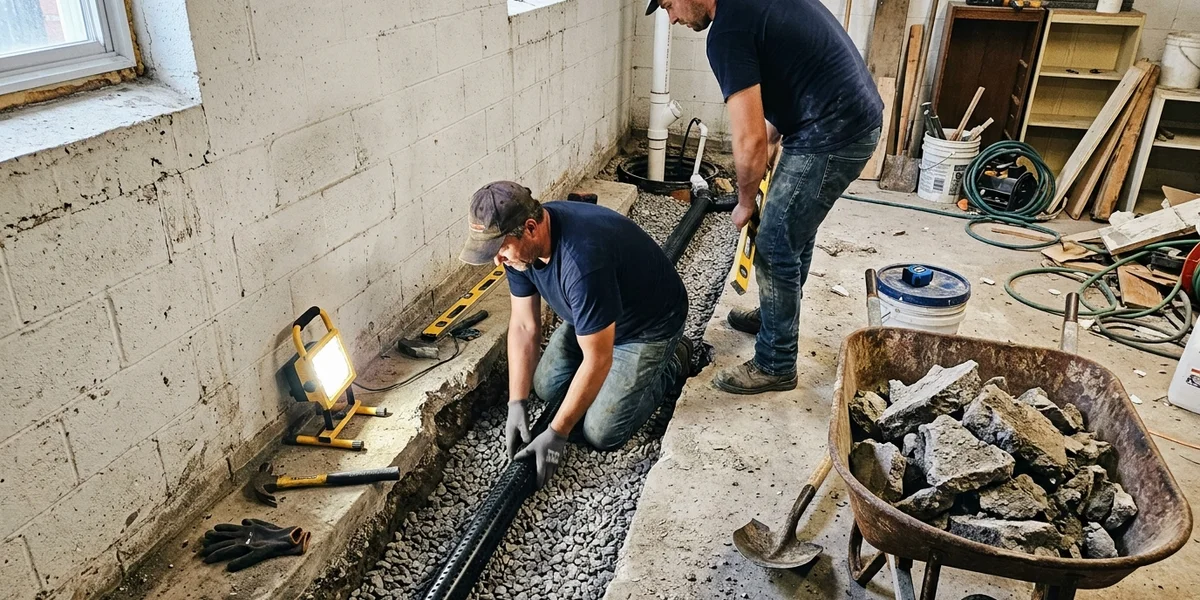
Foundation Waterproofing Toronto crew laying perforated PVC weeping tile in a sub-slab trench in a Toronto basement
Sub-slab perimeter channel to a sump pump SUB-SLAB DRAINAGE

Foundation Waterproofing Toronto provides basement waterproofing, foundation crack repair, sump pump and backwater valve installation, and interior and exterior weeping tile systems throughout Toronto, ON, backed by 25+ years of experience under Ontario Building Code Part 9.

Foundation Waterproofing Toronto installs interior weeping tile, a sub-slab perimeter drainage channel that collects footing water and diverts it to a sump pump, relieving hydrostatic pressure at the wall without exterior excavation. It is the basement waterproofing system our crew installs most across Toronto and the GTA, backed by 25+ years of experience, installed under Ontario Building Code Part 9 with a City of Toronto plumbing permit, and covered by a written workmanship warranty that passes to the next homeowner if you sell.

Scope CAD cost anchor

In 2026, interior weeping tile is $110 to $220 CAD per linear foot, or $8,000 to $18,000 CAD for a full basement perimeter. A submersible sump pump with a sealed basin adds $1,500 to $3,500 CAD. The in-home inspection is free.

  • 25+ years experience
  • OBC Part 9 compliant
  • Free in-home inspection
  • written workmanship warranty

Diagnostic Inspection Request

Free in-home inspection with a written diagnostic, anywhere in the Toronto GTA.

Prefer to talk now Call (647) 254-5110

  • 25+ Years Experience
  • Same-Day GTA Emergency Response
  • Written Workmanship Warranty
  • OBC Part 9 Compliant
  • Up to $3,400 CAD Subsidy Filed

How a Sub-Slab Perimeter Drain Keeps a Basement Dry

Interior weeping tile is a sub-slab perimeter drainage channel, and it is the basement waterproofing system Foundation Waterproofing Toronto installs most often in Toronto homes. The crew removes a strip of basement floor around the inside of the foundation, exposes the footing, and installs perforated PVC pipe in clear stone beside it. Water that would otherwise build pressure under the slab drops into that pipe and runs by gravity to a sump basin, where a sump pump lifts it out to the discharge line.

The second half of the system matters as much as the pipe. An air-gap poly drainage membrane, typically Delta-MS or Platon dimpled sheet, is fastened up the inside face of the foundation wall and tucked into the trench. Anything seeping through block cores, mortar joints, or the cove joint gap hits the back of that membrane and runs down into the drain instead of across your floor. That is why an interior system handles both under-slab pressure and wall seepage at once, and why it sits at the centre of most foundation waterproofing scopes we quote in older Toronto basements.

Why Toronto Clay, Narrow Lots and Old Foundations Favour Interior Drainage

Toronto’s housing stock and its lots both push toward interior drainage.

The soil is dense Halton Till clay that holds water. After a spring thaw, the water table around a footing can sit higher than the slab for days, which makes hydrostatic head pressure relief the only real solution. No coating survives that load indefinitely.

The lots are often narrow. In the core, from Riverdale and Leslieville to the Annex and Little Italy, a semi-detached or row house can sit a metre from the neighbouring wall, a side walkway may be poured concrete, and the rear yard may hold a deck or mature trees. Excavating to footing depth in that situation means destroying and rebuilding everything above it.

Many older foundations are rubble stone or block, especially in the 1910s to 1940s housing stock of East York, the Junction, and Cabbagetown. Membranes bond well to flat poured concrete and poorly to an irregular stone face. Interior drainage does not care what the wall is made of, because it collects water rather than trying to seal a surface.

What Your Basement Looks Like Each Day of the Job

Day one, concrete slab break-out. The work area is sheeted off. We cut a 12 to 16 inch channel around the treated perimeter using electric jackhammer trenching with dust extraction, and remove the spoil the same day.

Day two, drainage. The trench is levelled to fall toward the sump location, perforated pipe is bedded in 3/4 inch clear washed stone, and the air-gap membrane goes up the wall. A weeping tile flush port is set at each corner so the line can be cleaned out later without reopening the floor.

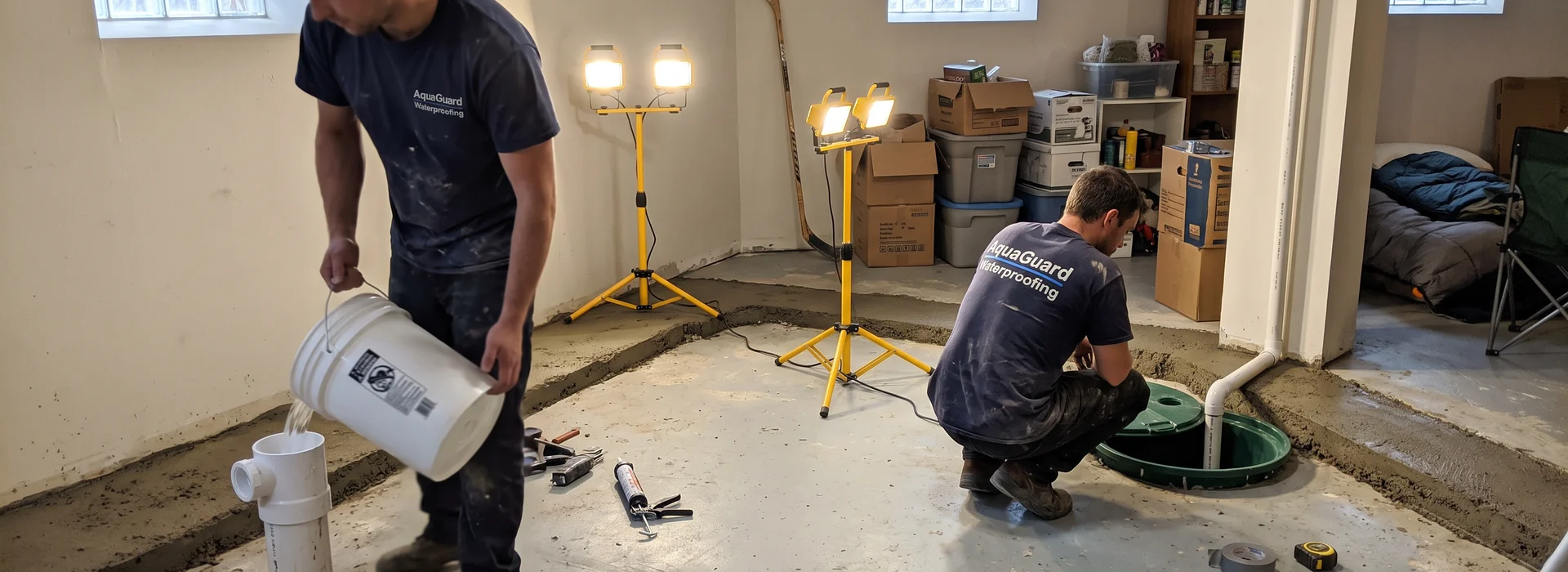
Day three, sump connection. The pipe is tied into a sealed structural basin. If the basin and pump are new, a CSA-certified submersible sump pump such as a Zoeller or Liberty Pumps unit is set, the check valve fitted, and the discharge routed above grade and away from the foundation.

Days four and five, restoration. Stone is topped up, the channel is repoured in new concrete, and the slab is screeded flush. We water test the complete run, confirm the pump cycles, close the plumbing permit, and issue the warranty.

Interior vs Exterior Weeping Tile: Cost, Disruption and Warranty

OptionCost in TorontoDisruptionWarranty
Interior weeping tile$8,000 to $18,000 CAD full perimeterInside only, 3 to 5 daysWritten workmanship
Exterior weeping tile and membrane$15,000 to $35,000 CAD full perimeterExcavation, landscaping affected, 5 to 10 days10-year workmanship
Crack injection only$500 to $1,800 CAD per crackOne visit, no excavation10-year
Interior plus exterior combined$20,000 to $45,000 CADBoth, phasedCombined coverage

Crack injection is a targeted foundation repair and the correct answer when a single crack in a poured concrete wall is the only entry point. Interior weeping tile is the correct answer when water arrives under pressure along the perimeter, which is the far more common case in a basement older than forty years.

How We Compare

What you getTypical providerFoundation Waterproofing Toronto
PricingQuoted only after a site visit$110 to $220 CAD per linear foot published on this page (2026 pricing)
ScopeFull perimeter by defaultPartial systems quoted where the diagnostic shows water on only some walls
Wall membranePipe only, wall left openAir-gap dimpled membrane on every treated wall, tucked into the trench
Clean-out accessOften omittedFlush port at each corner for future clean-outs
Plumbing permitLeft to the homeownerFiled, inspected, and closed out by our crew
WarrantyUnstated or verbalWritten workmanship warranty that passes to the next owner
Track recordUnstated25+ years, WSIB registered, $2M liability insurance

Planning a Rec Room or Secondary Suite? Drain Before You Frame

If the end goal is a rec room, a secondary suite, or a home office in a North York bungalow or an Etobicoke split-level, sequence matters. Drainage first, then vapour control, then framing. Insulating over a wall that still passes moisture traps water inside the assembly, and mould follows within a season. Once the interior system is in and tested, the wall can be framed with the code-required vapour detailing and the space behaves like any other conditioned room.

A partial system is often enough. If the diagnostic shows water along the north and east walls only, we quote the north and east walls. The per-linear-foot rate is published precisely so you can check the arithmetic against the plan yourself.

Book the free in-home inspection with the Foundation Waterproofing Toronto crew and you will get the linear footage, the CAD number, and the recommendation in writing before you commit to anything, whether the house is in the old city, North York, Etobicoke, or Scarborough. Interior drainage is one scope within our wider foundation waterproofing Toronto service, and the diagnostic tells you whether it is the one you need.
Diagnosis

6 Signs Your Toronto Basement Needs Sub-Slab Drainage

Interior weeping tile is the answer to hydrostatic pressure, not to every wet basement. These six conditions are the ones that point to it during a diagnostic.

  1. 01

    Water appears at the floor and wall seam

    Seepage at the cove joint is the signature of hydrostatic pressure under the slab, and it is exactly what a sub-slab drainage channel relieves.

  2. 02

    Water shows up along more than one wall

    A single crack leaks in one spot. Pressure under the slab produces damp patches at several points along the perimeter after the same storm.

  3. 03

    Your weeping tile is original clay

    Pre-1970 Toronto homes often still have clay footing tile that has silted, crushed, or filled with roots. A camera scope confirms it.

  4. 04

    Exterior excavation is not practical

    Narrow downtown lots, a neighbouring wall a metre away, a deck, or a poured driveway can all make interior the only sensible route.

  5. 05

    The floor slab itself is damp

    Moisture rising through the slab, not just at the edges, indicates a high water table under the footing that needs to be drained rather than sealed.

  6. 06

    You are about to finish the basement

    Framing over a wall that still passes water traps it. Drainage goes in before insulation, vapour control, and drywall, not after.

Our framework

The 6-Step Interior Weeping Tile Installation Process

A full-perimeter interior system takes 3 to 5 business days on a typical Toronto home. This is what happens on each of them.

  1. 1

    Protect and cut

    We sheet off the work area, then cut the slab perimeter with an electric jackhammer and dust extraction, exposing the footing.

  2. 2

    Excavate and bed

    Spoil is removed, the trench is levelled to fall, and perforated PVC pipe is bedded in 3/4 inch clear washed gravel beside the footing.

  3. 3

    Membrane the wall

    Air-gap dimpled membrane is fastened up the wall and tucked into the trench so wall seepage drops straight into the drain.

  4. 4

    Connect the sump

    The pipe runs by gravity to a sealed structural basin, with a flush port at each corner for future clean-outs.

  5. 5

    Repour the slab

    Gravel is topped, the channel is repoured in new concrete, and the surface is screeded flush with the existing floor.

  6. 6

    Test and warranty

    We water test the full run, confirm the pump cycles and discharges, close the plumbing permit, and issue the written workmanship warranty.

Published CAD Pricing

How Much Does Interior Weeping Tile Cost in Toronto?

Interior weeping tile is priced by the linear foot of wall you treat, so a partial system on two wet walls costs far less than a full perimeter. These are the published 2026 CAD bands, and the free inspection tells you how many linear feet you actually need.

Single Wall Section

$3,000 to $6,500 CAD

20 to 35 linear feet along one wet wall, tied into an existing sump where one is present.

  • Priced at $110 to $220 CAD per linear foot
  • Air-gap membrane along the treated wall
  • Slab repoured and finished flush

Two Wall Partial System

$5,500 to $11,000 CAD

The most common scope where water enters along one corner of the basement.

  • Covers the two walls the diagnostic identifies
  • Clean-out flush port at each corner
  • written workmanship warranty
Most requested

Full Perimeter System

$8,000 to $18,000 CAD

Complete perimeter channel, membrane, and gravity connection to a sump basin. 3 to 5 business days.

  • Entire basement perimeter drained
  • Air-gap drainage membrane on all treated walls
  • Water tested and warrantied in writing

Full Perimeter Plus Sump System

$9,500 to $21,500 CAD

Full perimeter with a new CSA-certified submersible pump, sealed basin, check valve, and high-water alarm.

  • Submersible pump and sealed structural basin
  • Silent check valve and alarm
  • Battery backup available as an add-on

Interior weeping tile carries a written workmanship warranty in writing. The plumbing permit and disposal are itemised separately on every quote.

Straight answers

What Toronto Homeowners Ask Before We Cut the Basement Floor

Do you really have to break my basement floor?

Yes, a channel roughly 12 to 16 inches wide around the treated perimeter. That is what gives access to the footing. The concrete is cut with dust extraction, the debris is removed the same day, and the slab is repoured and screeded flat before we leave.

Is interior weeping tile just managing water instead of stopping it?

That is a fair description, and it is the point. Water in saturated clay will always reach the footing. Interior drainage gives it a controlled path to the sump instead of an uncontrolled one through your wall, which is why the system carries a written workmanship warranty rather than a promise that the wall will never see water.

What happens if the power goes out during a storm?

A sump pump without backup stops when the power does, which is exactly when you need it. We quote an AGM or lithium battery backup pump as an option on every interior system, and we recommend it on any home that has flooded before.

Will the warranty survive if I sell the house?

Yes. The written workmanship warranty names the property rather than the owner, so it passes to the buyer with no registration fee. It is issued at project close-out once the water test passes and the plumbing permit is closed, and it is the document a buyer's home inspector asks for.

Why us

Why Toronto Homeowners Choose Us for Interior Weeping Tile

25+ Years of Foundation Waterproofing Experience

Interior weeping tile is the system we install most, on everything from 1920s rubble stone in Cabbagetown to post-war block in Scarborough.

Written Workmanship Warranty

Issued in writing at close-out, tied to the property so it passes to the next owner, and backed by 25 years of continuous GTA operation.

Published Per-Foot Pricing

$110 to $220 CAD per linear foot on the page, so you can calculate a partial system yourself before you call.

Plumbing Permit Handled

Interior systems connected to a sump need a plumbing permit. We file it, schedule the inspection, and close it out.

Clean Site Discipline

Dust extraction on every cut, spoil removed daily, and the slab finished flush so the floor is usable the day we leave.

Subsidy Coordination

Where the scope includes a sump pump, we file the Toronto Basement Flooding Protection Subsidy of up to $3,400 CAD on your behalf.

Our work

Interior Weeping Tile Projects Across the GTA

Documentary photos from Toronto basements and foundation trenches. Select any image to enlarge.

Customer Feedback

What Customers Say About Our Interior Weeping Tile

Verified project feedback from Toronto and GTA homeowners. Names are shortened for privacy.

Rubble stone foundation, water along two walls every spring. They installed interior weeping tile with the air-gap membrane in four days for just under $13,000 CAD. The written water test at the end was what sold us on them.
Jasper L.Cabbagetown
We only needed 40 feet, not the full perimeter, and they said so rather than upselling. Came in at $6,200 CAD with a new sump. The basement has been dry through two thaws.
Nadia F.Don Mills
We wanted the basement finished for a rental suite. They insisted on doing the weeping tile before framing and explained why. The warranty paperwork went straight into our tenant insurance file.
Curtis W.Birch Cliff
Answers

Interior Weeping Tile FAQs

How much does interior weeping tile cost in Toronto?
Interior weeping tile runs $110 to $220 CAD per linear foot. A full basement perimeter is typically $8,000 to $18,000 CAD, and adding a new submersible sump pump with a sealed basin is another $1,500 to $3,500 CAD.
How long does interior weeping tile installation take?
A full-perimeter job takes 3 to 5 business days. Concrete removal on day one, weeping tile and drainage membrane on day two, the sump connection on day three, and restoration on days four and five.
Is interior weeping tile as good as exterior?
They solve the problem differently. Exterior keeps water away from the wall and is the most permanent option where you can excavate. Interior relieves hydrostatic pressure at the footing, costs less, works on tight lots and irregular stone walls, and carries our longest warranty.
Do I need a permit for interior weeping tile in Toronto?
Yes, a plumbing permit is required because the system discharges through a sump. We file the permit, coordinate the inspection, and handle the close-out as part of the scope.
Will the new concrete match my existing floor?
The repoured channel is screeded flush with the existing slab and cures to a slightly different shade, which is normal on any concrete patch. If the basement is being finished afterward, flooring covers it entirely.
Can interior weeping tile be installed in a finished basement?
Yes, but the bottom section of finished wall and flooring along the treated perimeter has to come out first. We quote that removal separately so you can see the real cost of working around an existing finish.
What happens if the weeping tile clogs?
We install a flush port at each corner so the run can be cleaned out with a hose rather than reopening the slab. Clear washed stone and filter detailing keep silt out in the first place.
Does interior weeping tile need a sump pump?
Almost always. The channel collects water by gravity and needs somewhere to send it. Where a property has enough elevation drop to a storm connection, a gravity discharge is possible, but in most Toronto basements the answer is a sump.
Will this stop efflorescence on my walls?
It stops the mechanism. Once the footing water is drained and the air-gap membrane is in place, the wall stops wicking and the salt deposits stop forming. Existing efflorescence is brushed off during finishing.
Does interior weeping tile add resale value to a Toronto home?
It protects value more than it adds a fixed amount. A buyer's home inspector flags efflorescence, water staining, and original clay weeping tile, and those findings drive price negotiations. A documented interior system with a closed plumbing permit and a written workmanship warranty that passes to the buyer answers those questions on paper, and a dry basement can be finished as a rec room or secondary suite.
Does the Toronto Basement Flooding Protection Subsidy cover interior weeping tile?
The subsidy covers the sump pump portion, not the weeping tile itself. The City of Toronto pays up to $1,750 CAD toward a sump pump, $1,250 CAD toward a backwater valve, and $400 CAD toward pipe severance, to a maximum of $3,400 CAD. Foundation Waterproofing Toronto is a registered contractor and files the application when an interior system includes a new sump pump.
Do you install interior weeping tile outside the City of Toronto?
Yes. We install interior systems across the GTA, including North York, Etobicoke, Scarborough, Vaughan, Mississauga, Brampton, Markham, Richmond Hill, and Oakville. The free in-home inspection, the published per-linear-foot rate, and the written workmanship warranty are the same in every area.

Still have a question about your basement

Book a free in-home inspection and we will answer it in writing, with the scope and the CAD price on the same page.

Book Free In-Home Inspection
Same-Day GTA Emergency Response

Get a written interior weeping tile diagnostic for your Toronto home

Book the free in-home inspection and we confirm the water source, the scope, and the CAD price in writing before anyone picks up a tool.

  • Free in-home inspection with a written diagnostic
  • Published CAD pricing before any work starts
  • OBC Part 9 compliant, WSIB registered, $2M insured
phone_in_talk